



This spring, schools and districts are finally adopting the “Enhanced” ACT. One year into the rollout, we examine what the redesign has meant in practice, and how tutors, counselors, and colleges are responding.
Changes Long in The Making
In July 2024, at the ACT Enrollment Management Summit, a captivated audience of admissions and enrollment leaders gathered in a Chicago conference hall for the annual higher-education event, waiting to hear ACT’s latest updates.
The year’s forum was especially anticipated: former CEO Janet Godwin announced that the test was getting a major overhaul. “With this flexibility, students can focus on their strengths and showcase their abilities in the best possible way.” Godwin said in the company’s announcement briefing.
The redesign centered on two promises to students: greater flexibility and a shorter test. ACT framed the changes as a way to give students more choice in how they demonstrate their strengths while reducing the length and intensity of the exam experience.
The shift came after years of mounting pressure on standardized testing to feel less punishing and more adaptable, with ACT’s own rollout materials acknowledging that the previous format could be fatiguing.
Less than a year later, the enhanced ACT was offered online, to the excitement of many test-prep experts who had long been waiting for meaningful changes. “My initial reaction was, ‘Well, it’s about time,’” said Scott Webster, Clayborne’s COO.
But by the time the rollout reached schools and districts in spring 2026, what had sounded like a long-overdue update felt, for many counselors and students, more like a source of fresh uncertainty. “The honest answer is that the testing landscape right now feels genuinely unsettled for students, families, and counselors alike,” said Sandra Sohne-Johnston, director of college counseling at St. Anne’s-Belfield School. “Students, and their parents and guardians, want clear answers, and the current environment doesn’t always offer them.”
So in search of some of those answers, I decided to take the new test myself.
Believe it or not, the ACT had remained largely the same since I took it last in high school nearly a decade earlier. That also meant it had been years since I had last sat for any kind of standardized test, and even longer since I had been in a high school classroom, so you can imagine I approached the experience with more nerves than I expected.
When my preference test results came back SAT-leaning, that familiar anxiety kicked in. I had already finished college. I knew this score would change nothing about my life. And yet the moment I scrolled through the directions on the practice test and set my timer, suddenly, I was back in a high school gymnasium: rows of folding chairs, fluorescent lights, a sweaty brow, a dry throat.
The strange power of standardized testing is that even years later, it can make the stakes feel immediate again, especially for someone like me, who was never a natural-born test taker.
Granted I was more prepared back then. I had spent the summer working with an ACT tutor and ultimately raised my score by six points. But the most important thing I’ve gained with age is perspective, along with a much better ability to regulate and calm my nerves. This test was not going to make or break my future, just as it wasn’t going to back then. What I was really battling, at both ages, was my own high expectations for myself, the kind we carry with us no matter how old we are.
So after a brief pep talk, I pressed on, finishing the Reading and English sections (more my strong suits) smoothly while scrambling to cusp the time limit on Math. Admittedly, I opted out of the Science section. Even so, the experience reinforced what so many students already know: standardized tests are not just about content mastery, but about pacing, endurance, and learning how to manage your nerves under pressure.
As someone who now works as a writer and storyteller, I found myself unexpectedly grateful for how much of the verbal side of the test felt familiar. Years of writing, reading closely, and revising sentences had sharpened my instincts around grammar, vocabulary, tone, and structure in ways I probably take for granted day to day.
The exam did feel more manageable in chunks, less like an endurance contest. That difference matters. Ultimately taking the ACT now, with its changes and the distance of adulthood, I could recognize what I could not have named as a teenager: that standardized testing is partly an academic exercise and partly an emotional one. The questions measure what you know; the format measures how well you can remain steady while proving it.
So, What’s Changed?
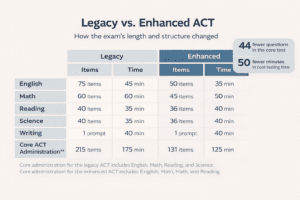
To get the important technical details out of the way first: the enhanced ACT has 44 fewer questions, gives students more time per question, cuts core testing time to 125 minutes from as much as 195, reduces math answer choices from five to four, and makes Science optional on national test dates while keeping Writing optional. The new Composite score is now based only on English, Math, and Reading, while Science is reported separately for students who choose to take it.
The broad goal, according to ACT, was to respond to what students, parents, and educators had been asking for: a test that felt shorter and more flexible without sacrificing rigor. “Students were telling us that they wanted a shorter and more flexible testing experience,” an ACT official told me. At the same time, the official said, they still wanted the exam to remain a valid measure of state standards and college readiness. ACT’s own research suggests that the shorter format may be able to do both: in studies comparing the enhanced exam with the legacy ACT, the organization found only minor losses in precision, with scores remaining comparable across versions and correlations with indicators like high school GPA and course rigor changing little.
ACT says the redesign was not rushed. The process took place over several years and included research, outside expert review, and pilot testing with a wide range of students before the new blueprint was officially rolled out. That feedback, the organization says, helped shape the final version and supported its conclusion that the enhanced exam still measures the same core skills and knowledge as the legacy ACT.
Let’s break down what those changes mean in practice:
More Time Per Question
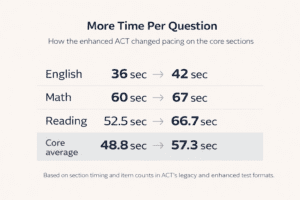
One of the most noticeable changes for students is pacing. Under the legacy ACT, completing the required English, Math, Reading, and Science sections could take as long as 2 hours and 55 minutes. Under the enhanced version, the required English, Math, and Reading sections take up to 2 hours and 5 minutes. ACT says the time savings come from multiple changes, including fewer questions in English and Math and the decision to make Science optional.
That does not necessarily mean the test is easy. In a standardized exam, “easy” is always relative to the scale: what matters is not simply how a test feels, but how scores are normed and interpreted against the broader pool of test takers. ACT’s national ranks, for instance, are based on the performance of recent high school graduates and are designed to preserve score meaning across administrations.
What the redesign may change, instead, is how punishing the test feels in the moment. According to ACT, one of the most common responses from students so far is that they feel more able to finish the required sections without the same degree of panic about the clock. “The biggest thing we are hearing most often from students is that they are better able to complete the required sections with less concern about timing,” the official said.
For years, one of the ACT’s less visible demands was not just mastering the material, but racing through it, a pressure that often fell hardest on students with test anxiety. The enhanced test appears designed, at least in part, to ease that particular burden.
Fewer Questions, Same Reliability?
The enhanced ACT is shorter and still nonadaptive in its digital form, which naturally raises a question: with fewer questions, does each one carry more weight?
ACT’s answer is that reliability has been preserved because the exam still measures the same underlying skills and knowledge as the previous version. The organization says it tested the redesigned blueprint extensively before rollout and found that it remained rigorous and valid. In other words, the company’s position is that the exam may be leaner, but it is not meant to be less stable or less trustworthy.
That distinction will matter most to students near admissions or scholarship cutoffs, where even small score differences can feel consequential.
Reduced Math Answer Choices
In Math, each question now has four answer choices instead of five.
On its face, that may seem minor. But for students, it subtly changes the rhythm of the section. Fewer choices can make elimination strategies a bit simpler and may slightly reduce the cognitive drag of sorting through implausible distractors. It also aligns the ACT more closely with the design conventions students may already recognize from other exams.
ACT has not framed this as a simplification of the content itself, but rather as one component of a broader redesign meant to improve pacing and usability while keeping the test rigorous.
The Science Option
The most consequential change, and likely the most debated, is that Science is now optional on national test dates.
ACT says this decision was central to the broader redesign. Making Science optional allowed the organization to shorten the core test while preserving what it sees as the exam’s rigor and distinctiveness. “Making the science test optional helped us deliver a shorter, more flexible testing experience while maintaining rigor and validity,” the ACT official said.
At the same time, ACT is careful not to diminish the value of the section. The organization notes that it remains “the only widely accepted college entrance exam with a test designed specifically to measure science skills.” For students testing on their own time, outside the school day, that means a new choice: take Science if demonstrating science reasoning is important for your goals, or skip it if you want a shorter, more focused exam.
For students applying broadly and trying to preserve as many options as possible, taking Science may still be the safer route. That is especially true because the policy landscape remains unsettled. Some colleges may require or prefer Science, particularly for STEM-oriented applicants, and counselors are still waiting for more consistent institutional guidance.
ACT’s message to colleges is that Science scores under the new format should still be treated as usable and comparable. Students who take the optional section continue to receive both a Science score and a STEM score, defined as the average of Math and Science. According to ACT, those scores are interchangeable with the Science and STEM scores provided under the legacy exam and can still be used in admissions and course placement for STEM-focused programs.
The complication is not that the score has disappeared. It is that the burden of deciding whether to include it, on top of whether to take the test on paper or digitally, now falls more heavily on students.
A New Core Composite
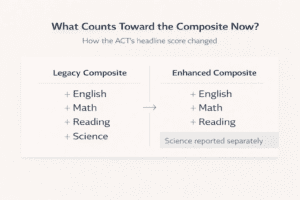
Under the enhanced ACT, the Composite score is now based only on three sections: English, Math, and Reading. Science is reported separately for students who take it.
This is a structural shift, not just a cosmetic one. For students who skip Science, the new Composite offers a cleaner, shorter path through the exam. For students who take Science, the score still matters, but it no longer shapes the headline number most people focus on first.
That may change how some students think about the ACT relative to the SAT. ACT says it expects the redesigned test to appeal especially to students who want “greater flexibility, a shorter testing experience, and continued reliability.” Whether that ultimately shifts the balance between the two exams will depend not just on ACT’s design choices, but on how clearly colleges explain what they want from applicants in this transitional period.
What Do Educators and Experts Think?
After the initial enthusiasm wore off from some of the test-prep experts here at Clayborne, the actual implementation of the redesign gave way to more practical questions: how nonadaptive digital testing will work with fewer questions, how colleges will treat optional Science, and whether students will ultimately gravitate back toward the ACT once the dust settles.
For tutors working directly with students, the redesign feels less like a clean simplification than a tradeoff. “While the enhanced ACT offers many advantages, these advantages come with potential downsides,” said Josh Nierle, a Clayborne tutor. With fewer questions, he explained, there is less room for recovery. “In the old ACT, if you thought the first fifteen questions were rough, there was always plenty of opportunity to turn it around in the next sixty questions.”
Still, he sees real benefits in the shorter format. “The reduced length, in terms of questions and time, of the Enhanced ACT benefits most students,” he said, “particularly those whose concentration levels may wane as the hours tick by.”
In that sense, educators and test-prep experts seem to agree on at least one thing: the redesign responds to real student pain points. Whether it resolves them is another question.
Does Optional Science Help Students — or Create More Confusion?
Science is the change that sounds simplest on paper and becomes messiest in practice.
For ACT, making Science optional was a way to offer flexibility and shorten the exam. For families trying to decide what that flexibility means, the answer is far less straightforward.
“It isn’t clear yet whether optional Science helps students,” Webster said. “The uncertainty mainly stems from not knowing exactly how schools will view these changes.” He suspects the admissions cycle ahead will be the real test.
Sohne-Johnston is even more direct about the confusion. “For students who determine the ACT is the right path, we strongly encourage taking the ‘classic’ format, including the science section, to ensure they are leaving as many doors open as possible,” she said. “We don’t think this is the moment to make assumptions about what colleges will or won’t require.”
That advice reflects a broader concern: optionality can feel empowering only when students have enough information to make an informed choice. Many do not.
“For students who do not have this level of support, the current landscape is a minefield,” Sohne-Johnston said. A student might take the enhanced ACT in the spring, she noted, only to realize in the fall of senior year that colleges on their list still expect a Science score. There is also uncertainty around superscoring between classic and enhanced formats.
Nierle sees that indecision playing out in real time with his students’ concerns. “Should I take the science section? What about the writing? Paper or digital?” he said. “The answers to these questions are contextual to each student, but center around which colleges and or careers the student is interested in.”
In other words, optional Science may help some students, but it also asks students to act like strategists at precisely the moment many are already overwhelmed.
Thinking in Terms of College Admissions
For all ACT’s assurances, the real anxiety for families is not whether the company believes in the new exam. It is whether colleges will.
ACT’s position is that students do not need to prepare in a fundamentally different way because the test still measures the same underlying skills. The organization also says colleges told them they will continue using ACT scores for admission, scholarships, and placement, and that institutions will not need to overhaul their score criteria because the new Composite remains comparable for decision-making.
That may be true in broad strokes. But on the ground, counselors are still urging caution.
Sohne-Johnston’s advice is rooted less in distrust than in pragmatism. “We encourage students to take the PSAT and a diagnostic ACT early, not to add pressure, but to gather information,” she said. Once students know which test better suits them, they can make a more strategic preparation plan. But for students who choose the ACT, her office currently recommends the classic format with Science “to ensure they are leaving as many doors open as possible.”
The concern is not that colleges will reject the enhanced ACT outright. It is that some may quietly value additional data, especially in competitive or STEM-oriented contexts, even if they do not say so loudly.
Webster expects selectivity to matter. “My expectation is that the higher the selectivity of the school, the more important having a strong Science score will be,” he said. “It will also be relevant for students who want to enter STEM.”
That does not mean every student should automatically take Science. It does mean that families should treat the decision as an admissions strategy question, not merely a convenience question.
What Hasn’t Changed
For all the upheaval, some of the most important things about the ACT remain intact.
The test is still scored on a 1–36 scale. It is still accepted by colleges. It is still linear rather than adaptive, meaning every student sees the same questions in the same order. It still tests the same broad academic areas, reading comprehension, grammar and usage, mathematical reasoning, and, for those who choose it, scientific interpretation. ACT also says its benchmarks remain unchanged.
That matters because reassurance, at this point, is not trivial. Families are not just trying to understand what is new; they are trying to understand what they can still count on.
And here, experts across the board seem to agree: the enhanced ACT is not an entirely new beast. It is a revised version of a familiar one.
“We here at Clayborne always have an eye on the future of test prep,” Nierle said. “We have already trained our tutors and updated our curriculum to reflect these changes.” That response captures the basic reality of the moment: the format may have changed, but preparation has not been reset from zero.
*This article was written by Kellie Kuenzle, Clayborne’s engagement and outreach coordinator.
Share this: