



Law school is having a moment.
According to LSAC’s publicly available cycle data, law school applications and applicants have risen sharply this cycle. Early snapshots showed year-over-year increases above 20 percent; by LSAC’s June 17, 2026 volume summary, ABA law school applications were still up 11.2 percent year over year and 36.4 percent over two years, while applicants were up 8.5 percent year over year and 29.2 percent over two years. The growth was broad, national, and unusually strong.
The surge is not just showing up in application dashboards. Reuters reported that the applicant boom has helped produce record or near-record first-year classes at several law schools, including Elon, Harvard, Rutgers, Hawaii, Pace, Liberty, Faulkner, and New Hampshire. In other words, this is not a theoretical admissions trend. More people are applying, more seats are being filled, and the legal education pipeline is getting more crowded.
The number of applicants scoring in the top LSAT bands has also risen significantly. By LSAC’s June 17, 2026 volume summary, the 175–180 band was up 16.8 percent year over year, with the 170–174 and 165–169 bands also up meaningfully. That matters because the LSAT has always been a sorting mechanism in law school admissions. But in a cycle where more people are applying, more people are submitting strong scores, and law schools still have only so many seats, a score that once felt safely elite may no longer stand out in quite the same way.
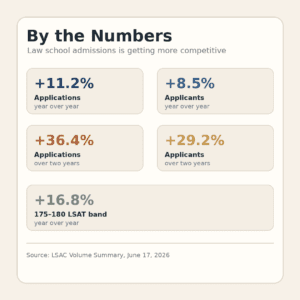
Early in the cycle, the very top LSAT score bands were up especially sharply. Even if those numbers moderate as the cycle continues, the basic story remains the same: the high-score pool is larger than it was a year ago, and applicants at the top are competing with more people who look statistically similar.
This does not mean every applicant needs a 175 to have a successful cycle. Most law school applicants do not. But it does mean applicants need to understand the landscape they are entering. The LSAT is not simply a box to check. In a more competitive admissions environment, it is one of the clearest levers applicants still control.
Why the surge changes the strategy
Law school admissions has always been numbers-conscious. GPA and LSAT score are not the whole application, but they shape the initial read. They influence school medians, scholarship decisions, waitlist movement, and how admissions committees compare applicants across institutions.
When applications surge, law schools have more choices. That does not automatically mean every school becomes dramatically more selective, but it does mean applicants are competing in a denser pool.
For students applying to highly ranked schools, the effect is especially important. A high LSAT score can still open doors, but it may need to be paired with stronger positioning, earlier submission, sharper essays, and a more carefully built school list. For students applying to regional or mid-ranked schools, the LSAT may be just as important for scholarships as it is for admission.
In other words, the question is not simply, “Can I get in?”
It is also: “Can I get in with options?”
That is where LSAT preparation becomes strategic. A few extra points can change an applicant’s school range, scholarship profile, and negotiating power. In a crowded cycle, those points matter.
That matters because law school is not just an admissions decision; it is a financial decision. A larger incoming class today may mean a more crowded entry-level legal market three years from now. Some legal-employment experts are already watching whether the applicant boom, combined with AI’s potential effect on junior legal work, could create pressure for new graduates. That makes scholarship leverage even more important. A stronger LSAT score can change not only where a student is admitted, but how much debt they take on to attend.
The LSAT itself has changed
Complicating all of this is the fact that the LSAT is not the same test many older prep books, online forums, and admissions advice articles still describe.
What is the opposite of the proverbial “gift that keeps on giving”? The taker who keeps on taking, perhaps? Whatever the phrasing, LSAC has given test-takers and tutors alike plenty to adjust to in recent years.
The biggest change already happened in 2024, when LSAC removed the Analytical Reasoning section — better known to most students as Logic Games. For longtime LSAT tutors, this was not a minor change. Logic Games had been a defining feature of the test for decades. It was also, in many cases, the most teachable section. Students who struggled at first could often make major gains once they learned how to diagram, recognize game types, and approach the section systematically.
That section is now gone.
The modern LSAT is built around Logical Reasoning and Reading Comprehension. That shift changes how students should prepare. It places even more weight on argument analysis, precision reading, inference, flaw recognition, and the ability to move quickly through dense text. Students who are still using outdated prep materials may be studying for a test that no longer exists.
This is especially important for students who heard that Logic Games was “the easiest section to improve.” That may have been true for many past test-takers. But post-2024, the path to improvement looks different. It is less about mastering diagramming systems and more about building repeatable habits for reasoning, reading, and eliminating wrong answers under pressure.
The at-home LSAT is ending
Another major change is coming in August 2026: the LSAT is moving back to in-center testing for almost all test-takers, citing test security concerns as the reason for ending the remote option.
Since the pandemic, many students have grown used to the option of taking the LSAT remotely. For some, that was a convenience. For others, it was central to their test-day plan. Students with test anxiety, transportation challenges, unpredictable schedules, caregiving responsibilities, or discomfort in formal testing environments often built their prep around the idea that they could test from home.
That option is now ending for most students.
Beginning with the August 2026 LSAT, LSAC says it will move to in-center testing for U.S. and international test-takers, with limited exceptions for certain medical accommodations or extreme distance from a test center. April and June 2026 were the final administrations offering the at-home option.
The exceptions are narrow. LSAC says remote testing may still be considered for test-takers with certain disability-related accommodations, assistive technology needs that cannot be met at a test center, active-duty military families stationed abroad, or domestic test-takers who are more than 180 miles or three hours from a test center with available capacity. For most applicants, the practical assumption should be simple: starting in August 2026, plan to test in person.
For students planning to test in August 2026 or later, this changes the logistics of preparation.
They need to know where their nearest test center is. They need to think about transportation. They need to practice taking the test somewhere other than their bedroom or kitchen table. They need to build stamina for a more formal testing environment. They may also need to adjust their anxiety-management strategies, especially if they were counting on the comfort and familiarity of remote testing.
For students with documented medical needs or serious distance barriers, accommodations may still be available. But those students should not wait until the last minute to understand the process.
The logistics piece should not be an afterthought. Test-center seats are not infinite. LSAC says Prometric can respond to demand by expanding hours, adding temporary sites, or adjusting capacity, but students should still treat registration and scheduling as part of the prep plan. Waiting too long may mean fewer convenient times, longer travel, or a testing slot that does not match when a student performs best.
A new testing platform means students need to practice differently
The return to in-person testing is not the only August 2026 change. LSAC is also moving the LSAT to a new LawHub test delivery platform.
LSAC has said the content and format of the LSAT are not changing with this platform shift. The change is to the user interface. But for a high-stakes timed test, interface changes are not trivial. Highlighting, underlining, answer selection, flagging questions, timer display, search tools, and navigation all affect how a student experiences the test.
Clayborne has already begun reviewing the new LawHub interface to see what students should expect. The transition appears designed to be modest rather than dramatic, but it is still a transition. Students can log into LawHub, select “new test,” and choose “August 2026 or later” to preview the new environment. As of mid-June, some functionality was still being completed, including tools such as answer-elimination features, though LSAC has indicated those features are coming.
The good news is that the essential tools are expected to remain: flagging questions, crossing out answers, search text, highlighting, and underlining. The appearance is somewhat different, and some actions may feel slightly clunkier at first. But with practice, August test-takers should have enough time to make the interface feel familiar before test day.
That matters. A student who is perfectly comfortable with the old interface may lose time if they first encounter the new one on test day. The goal is not simply to know the LSAT content. The goal is to know the testing environment so well that the platform itself becomes boring.
Why are more students applying?
The current surge has several likely causes. Law school applications tend to rise during periods of political uncertainty, economic anxiety, and heightened public attention to courts and legal institutions. That makes this moment unsurprising.
Part of the increase may be political. Admissions experts have pointed to the presidential election, the Supreme Court, and the prominent role of law in public life as possible reasons more students are considering legal careers. That makes sense. When courts, prosecutors, constitutional law, immigration, reproductive rights, AI regulation, and executive power dominate the news, law school begins to look newly relevant to students trying to imagine their place in public life.
But whatever the cause, the strategic implication is the same: applicants need to prepare for a more competitive environment. Law school may be newly attractive to students interested in public life, policy, advocacy, technology, government, or rights-based work. But that does not make admissions less numbers-driven. If anything, a larger pool makes the numbers matter more.
The bottom line
It is not too late to prepare for the LSAT this application cycle. But for students hoping to apply this fall, time is no longer abstract.
Clayborne typically recommends three to six months of preparation for best results, especially for students aiming for competitive scores or meaningful scholarship leverage. With law school applications rising, high LSAT bands getting more crowded, Logic Games already gone, remote testing ending for most students after June 2026, and a new LawHub interface arriving in August, applicants need a plan that reflects the test as it actually exists now.
The LSAT is still only one part of the law school application. But in this cycle, and especially with the changes coming in 2026, it is a part applicants cannot afford to treat casually.
Share this:
