
Let me tell you a story
When I found out Slinky Dog was closed at Disney’s Hollywood Studios, I turned to my wife and said: “this ruins our whole day.” We had built our entire rope drop strategy around this first ride. I had spent weeks planning, reading, and, yes, asking Claude AI about the optimal strategy so that we could get the most out of each Disney park. Thankfully, my wife is much more grounded than I am. She smiled and said, honey, we’ll just go to a different ride.
In that moment, I realized I had fallen into the very trap I warn my students about all the time. You cannot plan for everything. No matter how detailed the strategy, randomness still has a say in how the day unfolds. In fact, books have been written on how Randomness Rules Our Lives.
Listen to an interview about this here:
The Focusing Illusion: When Your Brain Tricks You About What Matters
Nobel Prize-winning psychologist Daniel Kahneman identified something he called the focusing illusion, which he summarized perfectly: “Nothing in life is as important as you think it is while you are thinking about it.”
The focusing illusion works like this: When your attention fixates on something—college admissions, wedding details, a job interview—your brain dramatically overestimates how much that single factor will impact your overall happiness and life satisfaction. Meanwhile, you completely neglect all the other variables that will actually determine how you feel: your daily routines, your relationships, your personal growth, and random opportunities you can’t predict.
It’s not that college doesn’t matter. It’s when you’re in the thick of applications that your brain makes you believe it’s the only thing that matters. Everything else fades into the background.
Research on the focusing illusion shows that people consistently overestimate how much specific life circumstances will affect their happiness. In one famous study, Kahneman asked people to rate how happy they thought Californians were compared to Midwesterners. People predicted Californians would be much happier because of the better weather. Reality? There was virtually no difference in life satisfaction between the two groups.
Why? Because weather is only one tiny variable in the massive equation of human happiness. Californians don’t spend every moment thinking about the sunshine—they’re stuck in traffic, dealing with difficult coworkers, arguing with their partners, worrying about bills, just like everyone else.
College admissions works the same way.
During Applications: When Every Detail Feels Existential
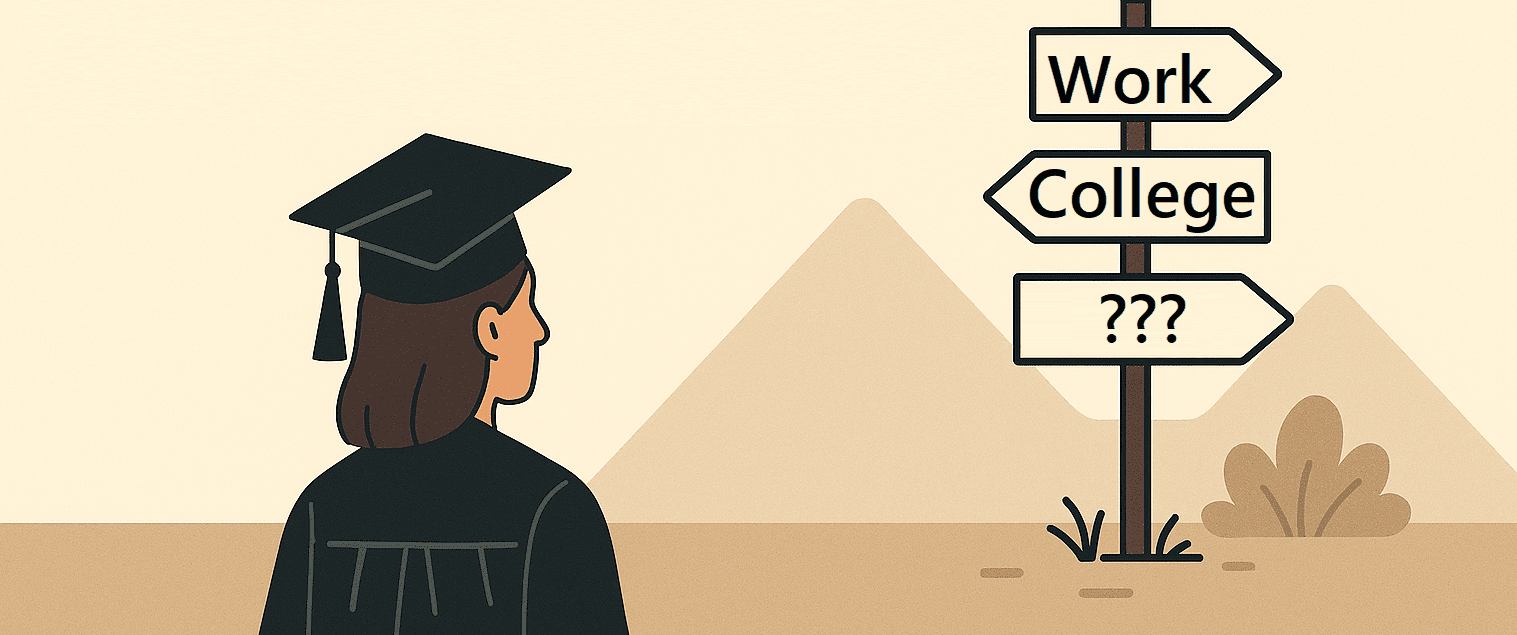
Right now, if you’re applying to colleges, everything feels weighted with cosmic significance. You’ve probably:
- Rewritten your personal essay opening line fifteen times, convinced that the perfect metaphor will unlock admission
- Agonized over whether listing debate team before Model UN could make a difference
- Stayed up until 2 AM perfecting the exact timing of your application submission
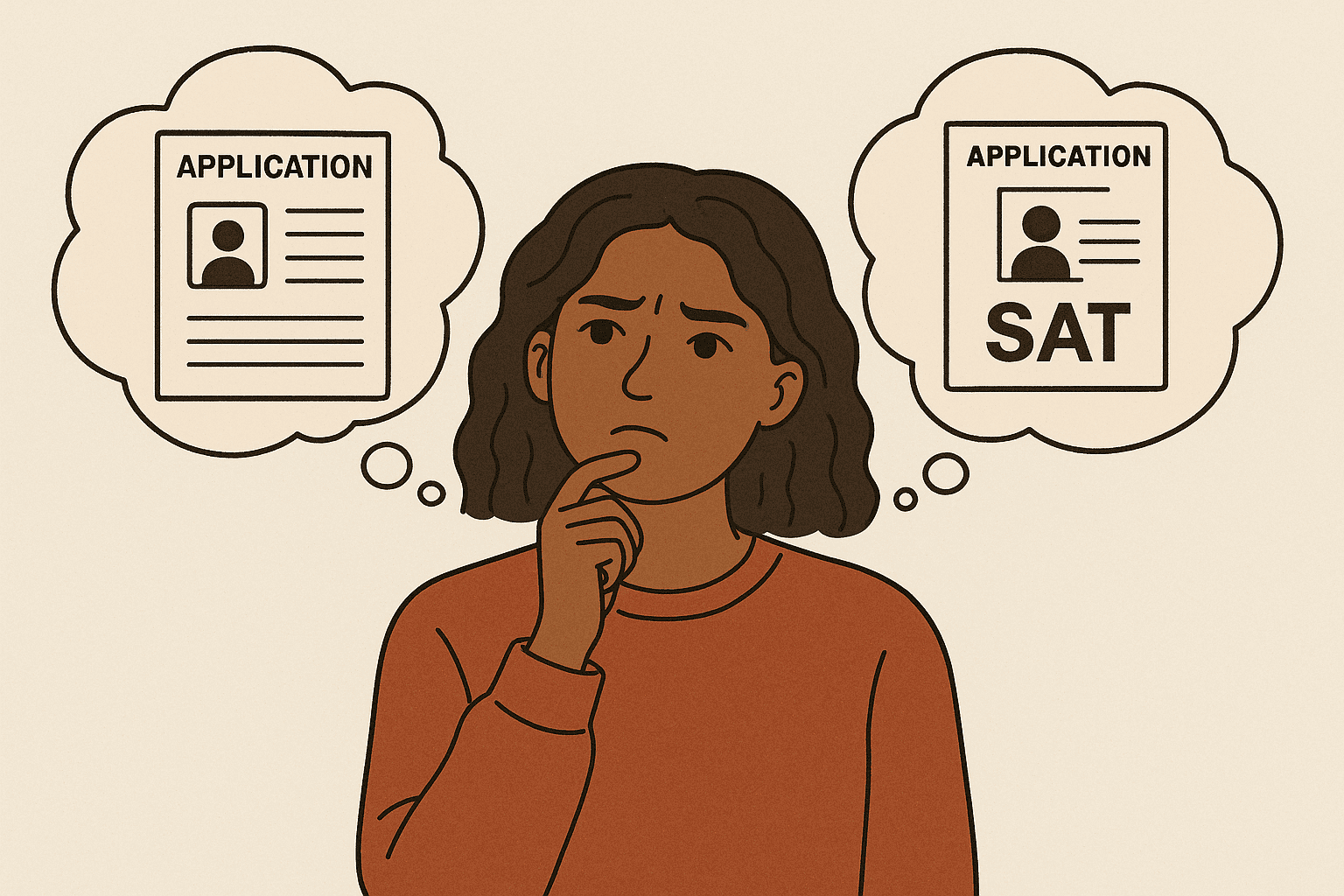
- Mentally calculated and recalculated your chances, refreshing forums obsessively
This stress isn’t irrational or overdramatic. It’s your brain responding to what psychologists call high emotional stakes and identity investment.
Why College Feels Like “Everything”
According to Self-Discrepancy Theory (developed by psychologist E. Tory Higgins), anxiety skyrockets when there’s a gap between:
- Who you are right now
- Who you think you should be
- Who you hope to become
College admissions activate all three discrepancies simultaneously. Getting into your dream school feels like proof that you’re becoming the person you’re supposed to be. A rejection letter feels like evidence that you’re falling short of who you should be.
Research insight: Studies on contingent self-worth (Crocker & Wolfe, 2001) show that when your self-esteem becomes tied to external achievements like college acceptances, your stress response intensifies dramatically. Your brain isn’t just processing an admissions decision—it’s processing what that decision says about your fundamental worth as a person.
Add in perfectionism—the fear of mistakes, concern over others’ evaluation, and harsh self-criticism—and you have a perfect storm of anxiety. You’re not just trying to get into college; you’re trying to craft a flawless application that reflects your ideal self, knowing that the process includes genuinely random elements you cannot control.
The Uncertainty Makes It Worse
After you hit submit, a new torture begins: waiting.
Psychologists studying the Intolerance of Uncertainty Model have found that some anxiety isn’t about danger—it’s about not knowing. Your brain tries desperately to reduce uncertainty through overthinking and overplanning. You refresh portals. You check forums. You calculate odds. You imagine every possible scenario.
This is your brain preferring any answer over no answer, even though rationally you know checking the portal for the fiftieth time won’t change anything.
“Your brain treats college applications like they’re the only variable in an equation with hundreds of terms.”
The Affective Forecasting Error: How We Get the Future Wrong
Here’s where it gets really interesting. Psychologists Daniel Gilbert and Timothy Wilson spent decades studying affective forecasting—our ability to predict how we’ll feel in the future.
Their findings? We’re terrible at it.
Specifically, we show something called impact bias: we consistently overestimate both how intensely we’ll feel about future events and how long those feelings will last.
What students predict:
If accepted to dream school: “I’ll be ecstatic for months! This will change everything!”
If rejected: “I’ll be devastated all spring. My future is ruined.”
What actually happens:
If accepted: You’re thrilled for a few days, maybe a week. Then you’re back to stressing about AP exams, prom drama, or whether your college roommate will be weird.
If rejected: It stings. It genuinely hurts. But within days, you start rationalizing (“Their loss,” “Maybe the other school is actually better,” “I heard their dorms are terrible anyway”). You don’t even notice yourself doing this.
Your Psychological Immune System
Why do we recover faster than we expect? Because of what Gilbert calls the psychological immune system—cognitive mechanisms that automatically help us bounce back from negative experiences.
Just like your body’s immune system fights off infections without you consciously directing it, your psychological immune system works in the background to:
- Make favorable attributions (“The admissions process is partly random anyway”)
- Reconcile conflicting thoughts (“This school wasn’t the right fit for me”)
- Restore self-esteem (“I’m more than where I go to college”)
The problem? Most people don’t know this system exists. Researchers call this immune neglect—we fail to account for our own resilience when predicting how long we’ll feel bad.
Key study: In Gilbert et al.’s 1998 research, participants consistently overestimated how long negative feelings would persist after major setbacks. What influences your mood after a college decision? Your friend throwing you a surprise party. A fight with your parents. A song you can’t stop listening to. The weather. These factors intrude on and dilute the impact of the college decision itself—but you never predict they will.
Fast Forward to Actually Being in College
Now imagine you’re a college sophomore. Someone asks, “Do you remember stressing about college applications?”
You laugh. “Oh my god, I was so stressed about whether to apply early decision. It literally didn’t matter.”
But here’s the thing: it did matter in the moment. The stress was real. The anxiety was genuine. What changed?
From Forecasting to Immersion: The Beautiful Shift
Psychologist Mihaly Csikszentmihalyi distinguished between two modes of consciousness:
- The evaluating self—which worries about outcomes, meaning, and future implications
- The experiencing self—which lives fully in the present moment
Before college, your evaluating self dominates. You’re constantly asking: “Will I make friends? Will I succeed? Will I belong? Did I make the right choice?”
Then you arrive on campus. And suddenly you’re:
- Trying to find your classroom in a building that makes no architectural sense
- Meeting your roommate and their inexplicable collection of decorative pillows
- Navigating the dining hall social dynamics
- Staying up until 3 AM having the kind of conversation that rewires your brain
- Bombing your first quiz and realizing the world doesn’t end
Your experiencing self takes over. And in that shift, something magical happens:
The exact phrasing of your college essay stops mattering. The SAT score difference that kept you up at night stops mattering. Even the school ranking starts to matter less.
Because lived experience replaces imagined evaluation.
What Actually Shapes Your College Experience?
After a semester, a year, four years, students realize something profound: the school didn’t define them. They grew because of what they did there.
Research on hedonic adaptation shows that people return to a relatively stable level of happiness regardless of positive or negative life events. College is no exception.
What students remember years later isn’t the carefully curated campus tour or the prestige ranking. It’s:
- The relationships: Your randomly assigned roommate who became your best friend. The professor who saw potential in you before you saw it yourself. The study group that turned into your chosen family.
- The challenges: The class that kicked your ass. The project you pulled together at the last minute. The rejection that redirected you toward something better.
- The autonomy: The freedom to explore ideas, change your mind, make mistakes, and figure out who you actually are versus who you thought you should be.
- The unexpected moments: The conversation that changed everything. The opportunity you stumbled into by accident. The random Tuesday that somehow became significant.
None of these things appear in a college brochure. None of them correlate with admissions statistics. And all of them matter more than where you go.
The Cruel Paradox
Here’s the most frustrating part: even knowing all this research, even understanding the focusing illusion and affective forecasting errors, you still can’t time-travel your future wisdom back to your present self.
Your 17-year-old brain, drowning in application season, cannot access the emotional truth that your 20-year-old self knows: where you went matters less than what you did there.
The stress is real because you’re living in a moment where the uncertainty feels unbearable, where the outcome seems to carry existential weight, where the focusing illusion makes you believe this one variable will determine everything.
You must care deeply about details that won’t ultimately matter, because caring about them is part of the process that will teach you they don’t matter.
That’s the paradox. The stress is the price of admission to the experience that reveals the stress was unnecessary.
What You Can Do With This Knowledge
Understanding the psychology doesn’t eliminate the anxiety. But it can give you permission to:
- Trust that your feelings will change. The devastation won’t last as long as you think. The ecstasy won’t either. Your psychological immune system is more robust than you imagine.
- Remember that your brain is playing tricks on you. The focusing illusion makes college feel uniquely important precisely because you’re thinking about it constantly. The moment you stop obsessing over it, its perceived importance will shrink.
- Recognize the randomness. Admissions decisions include genuinely arbitrary factors—which reader gets your file, what institutional priorities are that year, how you compare to an applicant pool you can’t see. You can’t perfect your way out of randomness.
- Focus on what you can control. Do your best work. Write honestly. Submit thoughtfully. Then let go. The obsessive optimization beyond that point is your brain trying to reduce uncertainty, not actually improving outcomes.
- Know that the story isn’t written yet. The details that will actually define your college experience—the friendships, the discoveries, the unexpected redirections—haven’t happened yet. They can’t be predicted, planned, or controlled. And that’s okay.
Further Reading & References
- Kahneman, D. (2011). Thinking, Fast and Slow. A comprehensive exploration of cognitive biases including the focusing illusion.
- Gilbert, D.T., & Wilson, T.D. (2007). “Prospection: Experiencing the Future”, Science, 317(5843), 1351-1354.
- Wilson, T.D., & Gilbert, D.T. (2005). “Affective Forecasting: Knowing What to Want”, Current Directions in Psychological Science, 14(3), 131-134.
- Crocker, J., & Wolfe, C.T. (2001). “Contingencies of Self-Worth”, Psychological Review, 108(3), 593-623.
- Higgins, E.T. (1987). “Self-Discrepancy: A Theory Relating Self and Affect”, Psychological Review, 94(3), 319-340.